Storia
Five systems know the guest. The person at the desk knows none of it.
What it is
A hotel already knows that the guest in room A204 is allergic to shellfish, landed three hours late, and complained about the air conditioning last night. It knows all of it in five different systems that never speak: the PMS, the CRM, the point of sale, the messaging tool, the review feed. The staff member at the desk knows none of it.
Storia is a layer above that stack, not another system of record. It ingests the signals, resolves one guest across all of them, and runs the result through rules the operator writes themselves. Those rules decide what happens next: a reversible note on a booking can go through on its own, anything a person cannot undo waits for a person.
Nothing reaches a guest without either a human approving it or a guardrail allowing it, and every one of those decisions lands in a hash-chained audit log the console verifies on open.
It is deliberately invisible to the guest. Storia never sends a message in its own name; everything the guest perceives comes out of the operator’s own systems. It is not a PMS, not a CRM and not a chatbot.
How it is put together
Three modules
-
Guest Signal
Ingests every system of record, resolves identity across them, and maintains a time-versioned profile.
Every field traceable to a source event.
-
Action Engine
Runs signals through operator-authored guardrails and produces actions, auto-executed or queued for a human.
One audit entry per action, always.
-
Operator Console
One pane for the shift: what is arriving, what needs a decision, and why the system suggested it.
Tablet-first, for a thumb at a front desk.
An action either auto-executes or waits, and both conditions must hold for the first: the guardrail above it granted auto-execution, and the action is reversible. The console feeds back into the engine only through a person, and that approval is itself an audit entry.
What to watch for
-
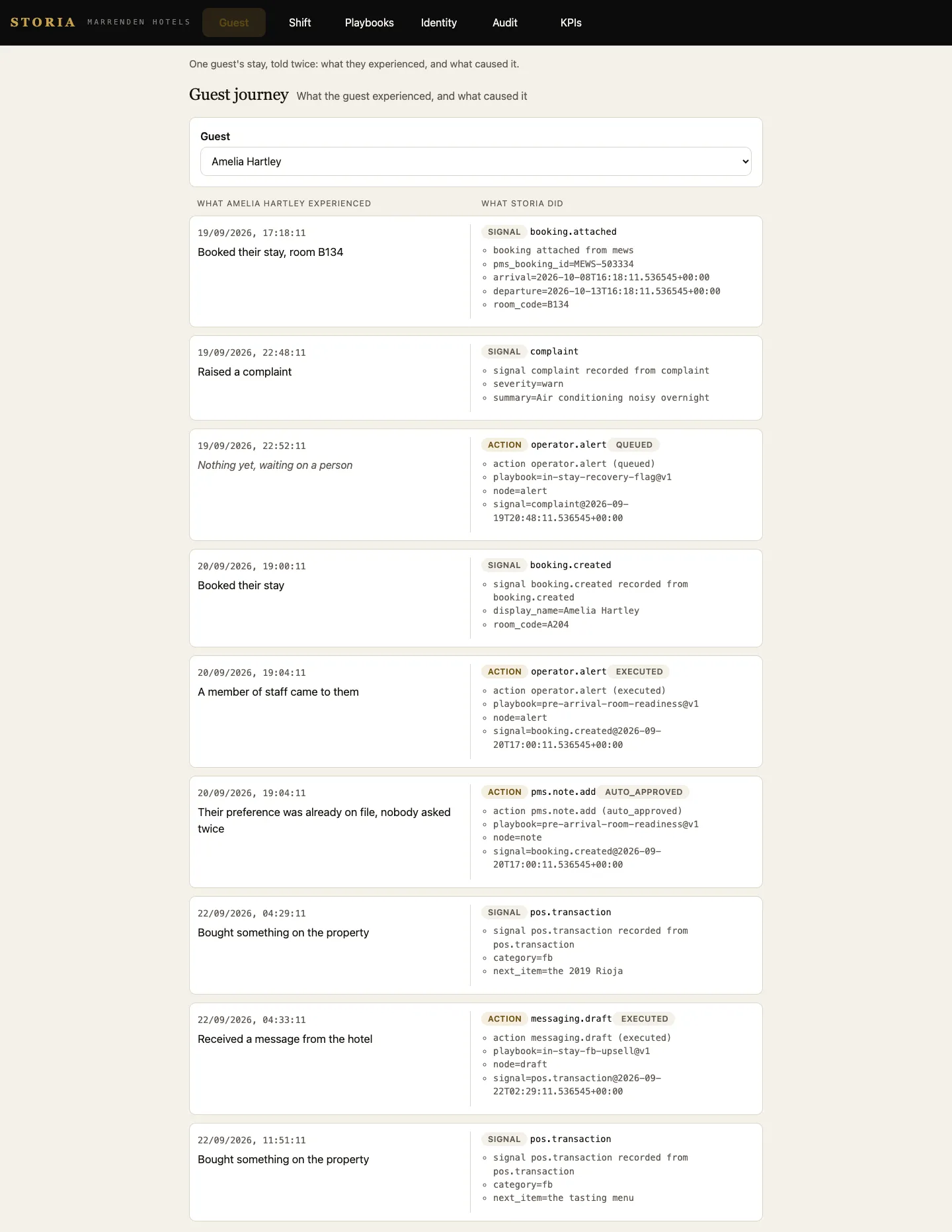
You land on Amelia Hartley, on the guest journey rather than the work queue. Two columns. The left is what the guest experienced, the right is what Storia did and why. They are the same events read from two sides.
-
Read down her journey. A booking arrives, a note is added to it on its own, and a housekeeping alert goes to a person who approves it. Watch the badges on the right, AUTO_APPROVED on the note and EXECUTED on the alert a human acted on.
-
Find the row where the left column says that nothing has happened yet and the action is still waiting on a person. That gap is rendered on purpose. A queued action has not happened, so the guest experienced nothing, and filling the space would tell the operator a flattering story about their own service.
-
The last purchase has nothing after it. That is the fatigue guardrail declining to act. The upsell playbook carries the rule suggestions_last_24h < 3, Amelia is already over it, so the branch is blocked and nothing reaches her. The system is at its most trustworthy in the moment it does nothing, and the only evidence is the absence.
-
Open the Audit tab. The green banner is not decoration. The console asked the server to replay every entry and recompute each digest from its predecessor, and the server said the chain holds. Then open Shift, where every card is something Storia wants to do and has not done, and the IRREVERSIBLE badge is why.